Mechanix
Mechanix Pursuit D5 Cut-Resistant Gloves, Black
Mechanix Pursuit D5 Cut-Resistant Gloves, Black.
49,95 €
Multiple options
Are you a bouncer or a security guard? This category features leather or fabric cut-resistant gloves with various protection levels. Personal protective equipment is classified according to legislation into three protection categories based on the severity of risks. The higher the risk users are exposed to, the greater the requirements for the gloves' protective features and certification. The legislation is drafted on a general level, while standards further specify it.
Cut-Resistant Category I for minimal hazards
Cut-Resistant Category II for moderate hazards
Cut-Resistant Category III for severe hazards;
...text continues below the products.
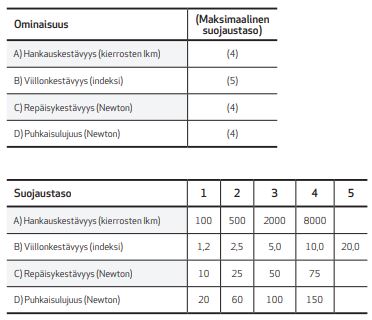
A. Abrasion Resistance
The glove material is rubbed against sandpaper under pressure. The test measures the number of abrasion cycles required to puncture the material. The highest protection level
is 4, which corresponds to 8,000 cycles.
B. Cut Resistance
This measures the number of cycles required for a blade rotating at a constant speed to cut through the glove. The results
are compared to a reference material, yielding an index number. The highest protection level is 5, which corresponds to an index number
of 20.
C. Tear Resistance
A cut is made into the glove material. Afterwards, the force required to tear the material apart is measured. The highest
protection level is 4, which corresponds to 75 Newtons of force.
D. Puncture Resistance
The test measures how much force is needed to create a hole in the glove with a nail of specified dimensions and
a certain speed (10 cm/min). Here, the highest protection level is 4,
which corresponds to 150 Newtons of force.